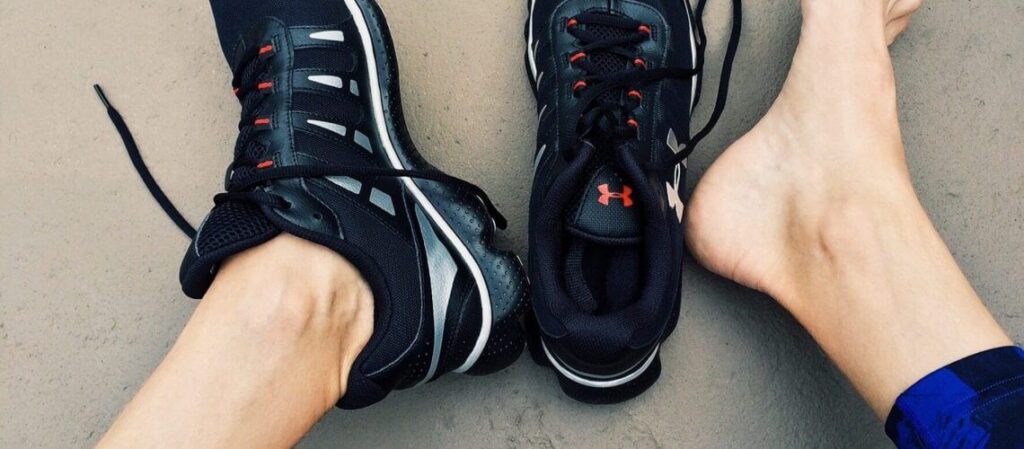
We are here to help if you find yourself suffering from an Achilles tendon pain and we are going to outline five simple steps you can take to help reduce it.
The Achilles tendon is a thick band of connective tissue that joins the calf to the heel of the foot. The Achilles tendon is designed to be very strong and to transfer the forces generated by the calf muscle through down to the foot.
Achilles pain will happen for one of two reasons;
Identifying the mechanism of injury (how it happened) will help you treat and prevent it occurring again.
For incidents involving trauma, you know the exact point it happened and ideally, you want to try and avoid doing it again.
An overuse injury is more common, but often it can be a little bit more difficult to identify so it is always recommended to see a physio or podiatrist to have a look into the cause.
Achilles tendon pain from overuse is better known as Achilles tendinitis and is most common in runners. Here are a few examples of that can trigger Achilles pain from running;
Ice reduces Achilles tendon pain by reducing swelling into the area and slowing the bodies pain signals to the brain, which also reduces swelling and the natural response to pain.
Some swelling is good as it is the body trying to repair and protect itself. But If it is not controlled then it can start to become detrimental to the healing process.
Always ice after a run or when it is painful. 20 minutes is the optimum time. This can be in one go or two blocks of 10 minutes with some gentle ankle movements in between.
It is important to stay mobile so using something like the Riixo Calf cuff will enable this. Complete rest may cause the Achilles tendon to become stiff and tight.
Using heat will help to increase blood flow to the area, increasing levels of oxygen and nutrients. You want to heat the calf at the same time.
This will increase the elastic properties, like warming an elastic band, reducing the stiff tight feelings and improving the movements of the ankle.
Use heat in the morning or before doing any exercise. Wear for 20minutes or longer and keep mobile whilst applying heat. Try to avoid any creams or lotions, a lot of the time they are a chemical irritation of the skin that gives the feeling of heat. You want to use deep radiating heat as the recovery cuff provides.
Ice for pain. Heat for movement
You don’t want to completely rest a painful Achilles tendon because this will just cause it to become more stiff and painful. By rest, we mean a reduction in what your current running levels are. You want to avoid the things that aggravate the Achilles tendon or cause any pain. If it is running then reduce to a walk or try the bike.
A good rule to follow are the POLICE principles;
Protection.
Compression garments to help protect the Achilles. Wearing supportive shoes is another way.
Optimal Loading.
Take as much as much weight through painful Achilles as you are able to, without aggravating the symptoms or waling with a limp.
Ice.
20 minutes to reduce pain and swelling.
Compression.
Provide support, protection and manage any swelling.
Elevation.
Having your foot elevated, even slightly, will help the body reabsorb and process any fluid or swelling to the area.
Placing a 0.5 – 1cm heel raise in your shoe under the heel of the painful Achilles will help to reduce the stretch on the tendon helping to reduce the pain. This can work on a temporary basis to alleviate any pain in the Achilles after running.
A longer-term solution would be to have the mechanics of your foot looked at to see if you would benefit from a pair of orthotic insoles.
specific stretching and strengthening exercises to promote healing and strengthening of the Achilles tendon and the surrounding muscles.
A type of exercise widely used is called eccentric strengthening (or eccentric loading). Exercises of this nature have been found to put a high load through the tendon but in a controlled lengthening movement.
An example is the single leg eccentric heel lowering.
Complete this exercise until you have done 12 on each side. Rest for 3 minutes then repeat the cycle again.

Cameron is a former professional rugby player who broke his back in 2007. He is a qualified physiotherapist with two degrees in Sports Science and Physiotherapy. Before Riixo he worked for the UK national health service (NHS), in professional sport and the British army. Read about his story.
 British Triathlon: Recovery Questions Answered
 The Injury Risk Equation
 LJMU Study Findings
 What are shin splints?
 How to treat shin splints [2021]
No Thanks – I’ll pay full price
Close Window
Close Window
