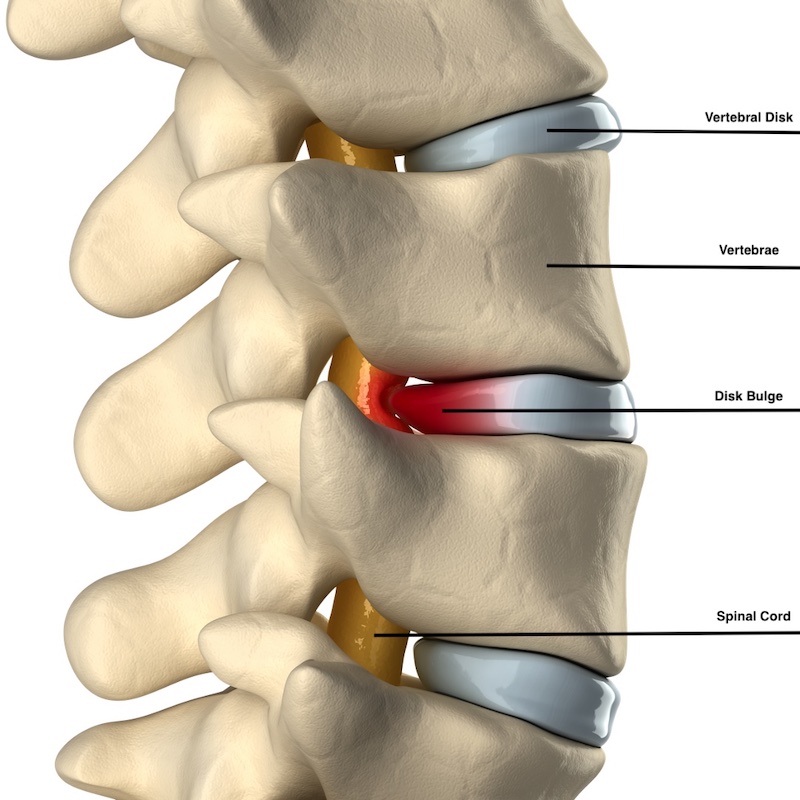
A herniated disk is caused by a bulge in the jelly-like substance between the spine's bones. It is often referred to as a slipped disk or a prolapsed disk.

A herniated disk, sometimes called a slipped disk or prolapsed disk, refers to a problem with one of the rubbery cushions in between the vertebra bones that stack together to form your spine.
The centre of the spinal disk is a soft jelly-like material called the nucleus and it is encased by a rubbery outer material (annulus).
A herniated disk occurs when the gel core of the nucleus is pushed out rough a tear in the rubbery annulus.
A herniated disk can happen anywhere on the spine but it is most commonly found in the lower back. The majority of the population will experience a herniated disk but often with little or no symptoms. People that do experience symptoms describe a pain in the back and, depending on where the injury occurs, some tingling or numbness in the legs or arms.
The symptoms of a herniated disk tend to resolve themselves over time and surgery is not usually required to relieve the problem.

Localised low back pain. This is often not a direct result of a herniated disk but due to the protective spasms in the muscles of the low back or from trauma. When the body recognises that you have an injury it will do what it can to repair and protect the area. That can be through swelling and inflammation, or from the muscles tensing up to limit movement in the area. Vertebrae
Arm or leg pain. This will depend on where the herniated disk is located and the pain is often referred to as a dull ache or “toothache” type of pain. It will be difficult to put your finger on the area as the pain is actually referred pain from the spinal disk.
You may experience a ‘shooting pain’ during quick movements or if you sneeze.
Numbness and tingling in the feet and hands.
Weakness in the muscles of the legs or arms. You may find it difficult to stand up from a seated position or to grip an object in your hand.
Disk herniation is most often the result of gradual, ageing-related wear and tear called disk degeneration. As people age, the disks become less flexible and more prone to tearing or rupturing with even a minor strain or twist.
Most people can't pinpoint the cause of their herniated disk. Sometimes, using the back muscles instead of the leg and thigh muscles to lift heavy objects can lead to a herniated disk, as can twisting and turning while lifting. Rarely, a traumatic event such as a fall or a blow to the back is the cause.
Factors that can increase the risk of a herniated disk include:
The natural ageing process can be a contributing factor to a herniated disk. Body tissue, such as the disks in the spine, will naturally become drier and brittle making them more susceptible to damage.
Heavy lifting can put excessive force on the spine increasing the risk of a herniated disk. High-demanding jobs or ones that involve repetitive movements such as bending or twisting will also increase your risk.
Smoking can increase your risk of a herniated disk as it decreases the oxygen supply to the disk causing it to dry out quicker.
Frequent driving or sedentary jobs place excessive stress on the lower back and increases the risk of a herniated disk. The vibrations from driving can also increase that risk.
Being overweight can place additional stress on the lower back and the disks in the spine. With increased loading through the spine, you are at a higher risk of a herniated disk.
Avoid any heavy lifting this will reduce the risk of further injury and making the disk bulge worse. In most cases, a herniated disk will correct itself if you look after the spine and give the body time to heal.
Heat and ice can be used to treat the symptoms of a herniated disk, mainly the muscles supporting the spine. The muscles will go into a protective spasm to protect the spine but if left untreated they can become very painful themselves.
Ice can help treat the symptoms of a herniated disk by providing localised pain relief over the area of the spine. It can help reduce any inflammation in the area as well as help the muscles to relax.
Heat can be used to treat the symptoms of a herniated disk by improving mobility to the area if the muscles are tight and the back feels stiff. It does this by relaxing the muscles and stimulating blood flow to the area.
A simple way to remember is:
Ice for pain
Heat for mobility.
Physical exercise. Speaking to a physio will help you to better understand what you can do to improve your symptoms. Simple extension exercises can assist the body in repairing the herniated disk as well as improving your posture and control so that it is less likely to happen again.
In some cases, you may require further medical intervention. You will most likely require an MRI scan to determine if there is a herniated disk and the doctor may offer you one of the following treatments:
The information on this site is intended for educational purposes.
You must not rely on the information on this website as an alternative to medical advice from your doctor or other professional healthcare provider. If you have any specific questions about any medical matter you should consult your doctor or other professional healthcare provider. If you think you may be suffering from any medical condition you should seek immediate medical attention. You should never delay seeking medical advice, disregard medical advice, or discontinue medical treatment because of information on this website.
No Thanks – I’ll pay full price
Close Window
Close Window
