
Whether you're pursuing peak performance or gearing-up to conquer your next big event, the last thing you need is a badly timed injury.
If you’re pushing performance, you are making demands of your physiology, and whilst it’s impossible to eliminate injury risk entirely, you can significantly reduce your risk of an injury occurring.
In fact, you can cut injury risk to less than a third of what it might otherwise have been.
How?
There’s an injury “equation” you can follow. Three variables, you can influence to minimize the risk of injuries.
Consider this: the average overuse injury requires 10 weeks and a day to overcome. It’s clear how a poorly timed injury could undo weeks of hard work and preparation as you peak for an event.
To cut the probability of injury the three dependent variables to optimize for are your:
But why are these factors crucial in reducing injury risk? Let’s break them down.
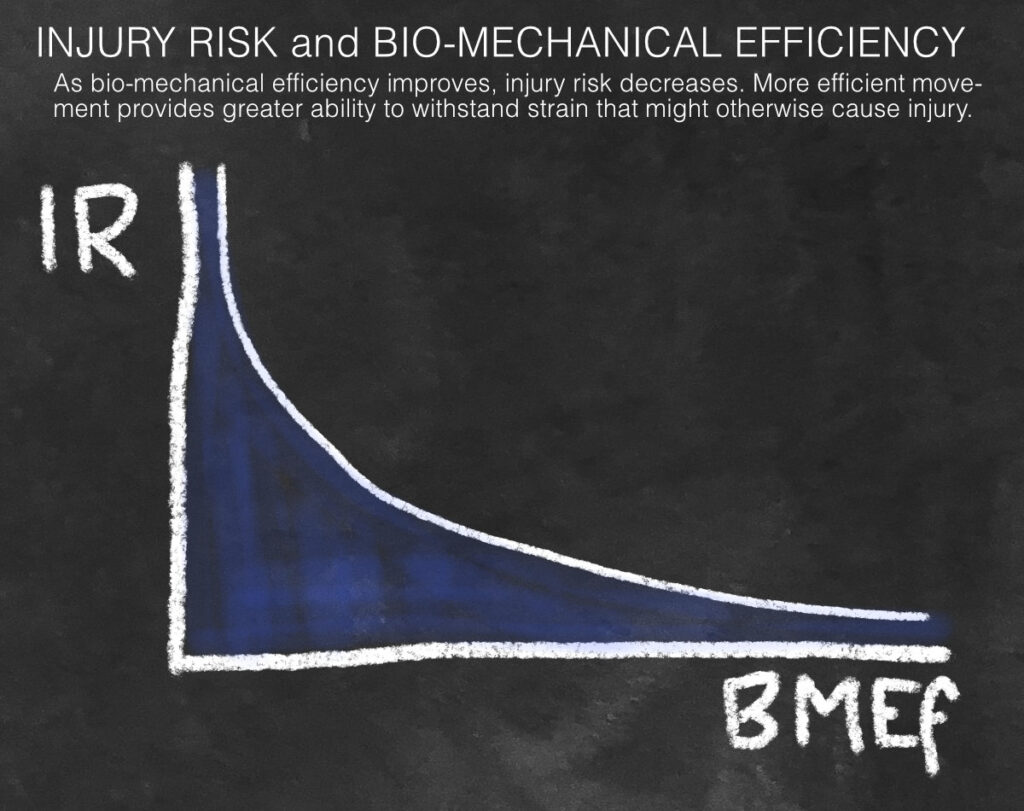
1. Biomechanical Efficiency:
Improving your biomechanics isn’t an overnight feat. While certain physical attributes are fixed, you can train and refine your biomechanics over time. By honing skills, working on your form, bolstering strength and stability, in time you’ll become a more efficient athlete. Reducing the strain on your muscles and joints and increasing the capacity for additional performance forces.
2. Exercise Load:
You could be supremely efficient. A graceful swan of an athlete. You could be the Roger Federer of your chosen sport. But if your load is all wrong your injury risk curve will jump higher.
Load could be cumulative, or it could from a single session.
If your recent training load has been low – perhaps through a period of injury or because of unexpected “life events” – your risk of injury is heightened. You will have experienced a period of decondition which make you more susceptible to injury.
If you’re feeling tired or have had a demanding day. If, maybe, there’s lots on your mind or some stresses at work, listen to your body and be attuned to how it’s responding to a session as the load climbs.
If things don’t feel quite right, react to that feedback. Adjust your session and keep listening to your body.

3. State of Fatigue
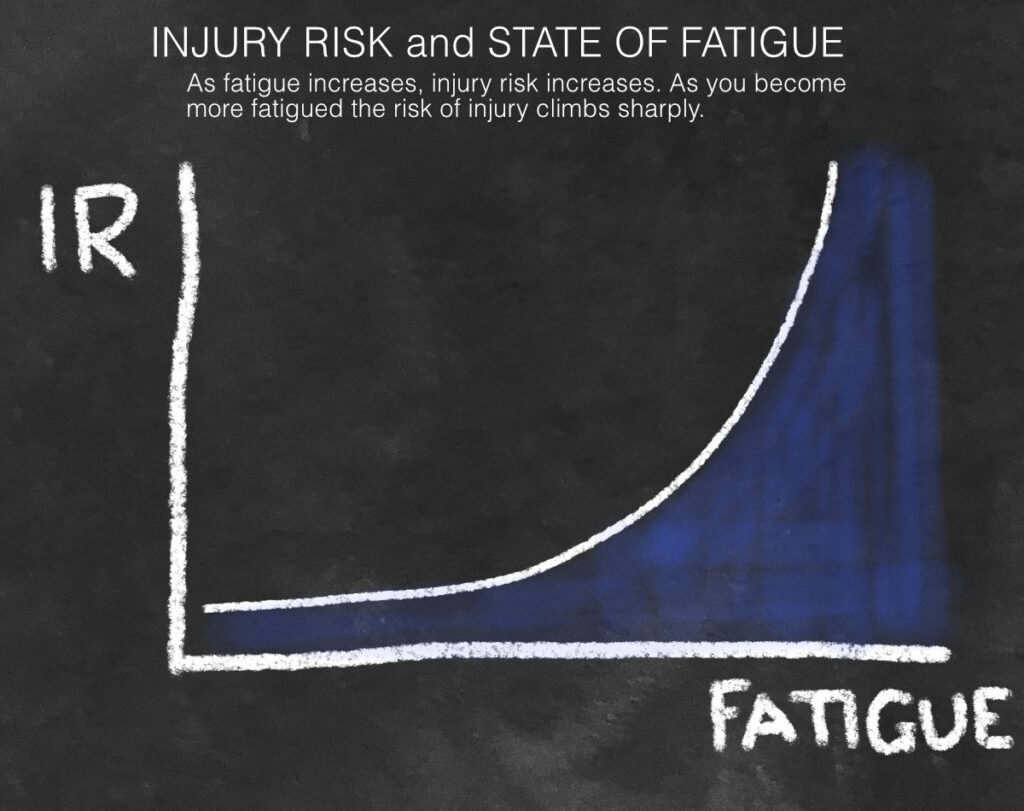
Your level of fatigue is the most dynamic element of the injury risk equation. Think of it more as a spectrum rather than a binary state – of being tired or not.
When operating in a state of depletion your injury risk is heightened. To crush fatigue, prioritize recovery between sessions by adopting effective and convenient protocols and also consider how you can implement “in-game” recovery strategies to manage the rate you tire at while training.
See how your recovery compares and how you can boost your charge going into every session: SCORE YOUR RECOVERY
Common mistakes
Unexpected injuries do happen, however in non-contact sports, there are usually warning signs that your physiology is under strain and you’re at a higher risk of injury.
Side-step a common injury scenario by avoiding the Training Catch-up trap.
This is when you miss a planned session – an unexpected work commitment, an ill child, a blown boiler – and rather than recognising the additional stress is itself fatiguing, there is a temptation to catch up by adding the missed session back into an already hectic schedule.
Action you can take today:
Action you can take now:
It takes 3 minutes to Score Your Recovery. Benchmark your recovery and access an Insights Report that shows you where your Quick Wins are.
This content forms part of Riixo’s goal to make sport science more accessible for its community of athletes. Goal-orientated athletes tend to love their sport so much it hurts. We’re here for you. To help by providing accessible insights, that have been researched, and give you an ability to recover better so that you can power your next performance. Don’t ever stop.
 British Triathlon: Recovery Questions Answered
 The Injury Risk Equation
 LJMU Study Findings
 What are shin splints?
 How to treat shin splints [2021]
No Thanks – I’ll pay full price
Close Window
Close Window
