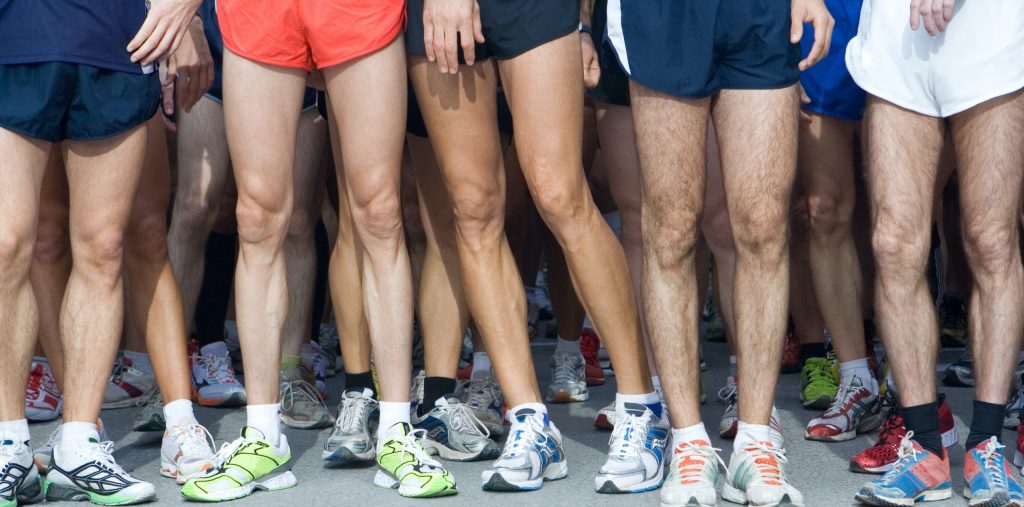
The knee is the most commonly injured joint among runners. Apart from bones, the most common structures to be affected are the soft tissues such as:
The most common injury in runners is Runners knee, also known as patellofemoral pain syndrome (PFPS). This is actually a bit of an ‘umbrella’ term that encompasses a few different pathologies in the same area. Runners knee is knee pain associated with your patella or kneecap. It can be caused by a strength imbalance in the muscles that support your knee, and/or, mechanical errors that can cause poor knee tracking.
The main symptom is pain around your knee when you run. The pain can be dull or sharp and usually worsens as the intensity of exercise increases.
Two common injuries that contribute to runners knee are:
Chondromalacia Patella (CMP)
Chondromalacia patella is damage to the cartilage behind the knee cap. This is a chronic condition that causes your kneecap cartilage to become irritated, soften and then break down resulting in pain and inflammation. The primary cases for CMP are mal-tracking of the knee cap causing the surface to rub, overuse and ageing.
The pain will typically be worse going upstairs and aggravated by long periods of sitting down with the knee bent.
Patellar Tendonitis (Tendinopathy)
Patellar tendonitis is generally an overuse injury but it can also be linked to ageing. The injury results from the patella tendon being repeatedly over stressed and can be happy if there has been a sudden change to training or footwear without the correct build-up. It can also happen if you have an injury on the opposite leg due to the body trying to compensate.
Patella tendinopathy usually causes pain, stiffness, and loss of strength in your knee. In most cases, it is easy to pinpoint as you can physically press on the area with your finger.
There are more than 100 different types of Arthritis but the two most common and most likely to impact the knee are:
Your iliotibial (IT) band is a long tendon that runs down the outside of the upper thigh connecting your knee to your hip. It attaches to the hip flexors and to the glutes and helps to provide stability to the knee.
IT band syndrome (ITBS) can occur due to overuse of the hip flexor muscles, overstrain and altered biomechanics. As increased tension is applied to the ITB it often becomes irritated and inflamed. Interestingly the main symptom is pain on the outside of your knee.
The anterior cruciate ligament (ACL) and the posterior cruciate ligament (PCL) are the two main ligaments inside the knee. They look like a cross as they overlap and their primary job is to hold the knee together. An ACL or PCL tear normally occurs during a traumatic incident that overstretches the ligaments such as the foot being planted and the body continuing to twist. It can occur when a runner stops suddenly, changes direction rapidly, whilst slowing down, landing incorrectly or has a slip and fall.
For a full rupture, there is often a ‘POP’ that is heard, a brief moment of pain followed by immediate swelling and a feeling that the knee is ‘loose’ or ‘unstable’. In most cases, the knee will require surgical intervention to repair it.
Partial sprains can be very uncomfortable. There may not be any audible sound heard at the point of injury. There will be a sharp sudden pain with immediate swelling that will gradually increase over a 24hr period. The knee may feel like a balloon that has been filled to capacity with water.
A bursa is a small fluid sac that acts as a cushion between bones and soft tissue to help reduce any friction. Prepatellar bursitis is an inflammation of the bursa that sits in front of the kneecap.
It can be caused by increased repetitive friction on the area, muscle tightness from the quads, or from a sudden injury to the knee.
The meniscal cartilage sits in the knee and acts as a shock absorber to the joint as well as providing smooth surfaces to prevent the bones from rubbing against each other. A tear to the cartilage in your knee joint will cause pain inside the knee. Often people describe a ‘locking’ of the knee, where the knee is just stuck in a position until the person shakes it free. This is due to the knee getting blocked by a piece of torn cartilage.
The mechanism of injury is similar to that of an ACL tear with a twisting of your knee when your foot is on the ground. It can also occur through direct impact in contact sports and in older athletes through gradual degeneration.
 British Triathlon: Recovery Questions Answered
 The Injury Risk Equation
 LJMU Study Findings
 What are shin splints?
 How to treat shin splints [2021]
No Thanks – I’ll pay full price
Close Window
Close Window
