We consider a study called Custom-Fitted Compression Garments Enhance Recovery from Muscle Damage in Rugby Players by F Brown et al. and published in The Journal of Strength and Conditioning Research, 2020.
This paper finds that fitted compression garments, with a higher level of pressure, secure significantly more recovery benefit than “off the shelf” compression products.
Its findings add to other recent studies on the benefits of an optimum level of compression for athletic recovery and the need for more accuracy rather than using height and weight to determine the correct size
Rugby Union is a high-intensity, high-impact, high-strength game. It is unsurprising that recovery protocols are well tested and researched within the sport. The high toll of matches, training and the relatively fast turnaround between fixtures make a focus on recovery essential.
This study uses a population of active rugby players with at least 2 years of experience in the sport. They were divided into three groups by a third party:
All participants undertook the same program of drills to achieve the exercise induced muscle damage.
Each athlete completed a set of standard tests to measure and understand how their recovery was impacted by the garment choice. These were conducted in advance to establish a baseline, immediately after the exercise program, again after 24 hours and then 48 hours.
Muscle Strength Test: Peak knee-extension force
This shows the recovery of lower-body strength performance. Subjects were seated (knees and hips at 90 degrees) and a strain gauge was used to measure the force of their knee extensions. The baseline measure is taken in advance of the protocol and it is compared to the performance immediately after and then at 24 hours and 48 hours.

Muscle Function Test: Percentage change in Countermovement Jump Height (CMJ)
CMJ is a standardised method for measuring an athlete’s explosive lower body power. The participant stood on a force plate and with their hands on their hips. They were asked to jump with maximum effort.
| Group | Baseline | Post-exercise | 24 hours | 48 hours |
| Custom Fit | 100 | 94.4 | 98.2 | 98.0 |
| Size Guide Fit | 100 | 94.2 | 97.0 | 98.4 |
| Control | 100 | 94.6 | 97.7 | 95.5 |
Performance Test: 30m Sprints
Electronic timing gates were used to measure performance. As with the other tests, the best score from three attempts was used. To minimise the chance of error, all data was recorded using the same equipment and the same researcher.
| Group | Baseline | Post-exercise | 24 hours | 48 hours |
| Custom Fit | 100 | 103.0 | 101.7 | 101.0 |
| Size Guide Fit | 100 | 104.9 | 103.1 | 103.0 |
| Control | 100 | 106.0 | 104.1 | 105.4 |
Creatine Kinase: A blood marker for muscle damage
When a muscle is damaged a protein call Creatine Kinase (CK) leaks into the blood stream. Thus finding elevated levels of CK in the blood is an indication of muscle damage.
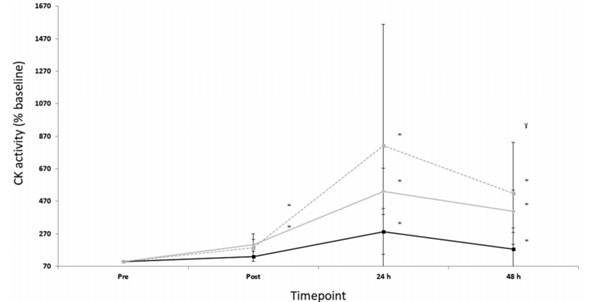
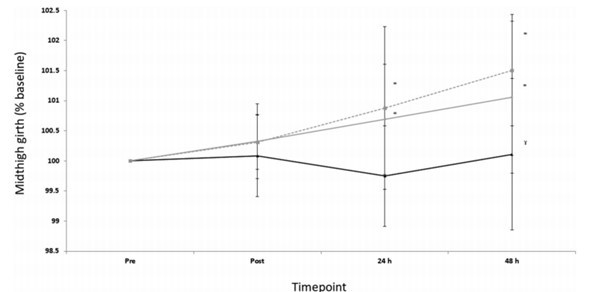
Midthigh Girth (MTG) is taken as a measure of muscle swelling brought about by the exercise
A lower outcome through the recovery period indicates less swelling and an improved recovery performance
In this study muscle soreness climbed significantly after exercise in all participants however the application of compression did not significantly influence the level of muscle soreness during recovery. However, the control group reported soreness 34.2% and 29.3% higher than the high compression group at 24 and 48 hours respectively.
The authors conclude that well-fitted, high-pressure compression garments significantly enhance recovery.
They note that this study’s finding, which builds upon other recent research, would be enhanced further by next using groups of athletes with more consistent abilities.
[Link to other blog posts]


 British Triathlon: Recovery Questions Answered
 The Injury Risk Equation
 LJMU Study Findings
 What are shin splints?
 How to treat shin splints [2021]
No Thanks – I’ll pay full price
Close Window
Close Window
